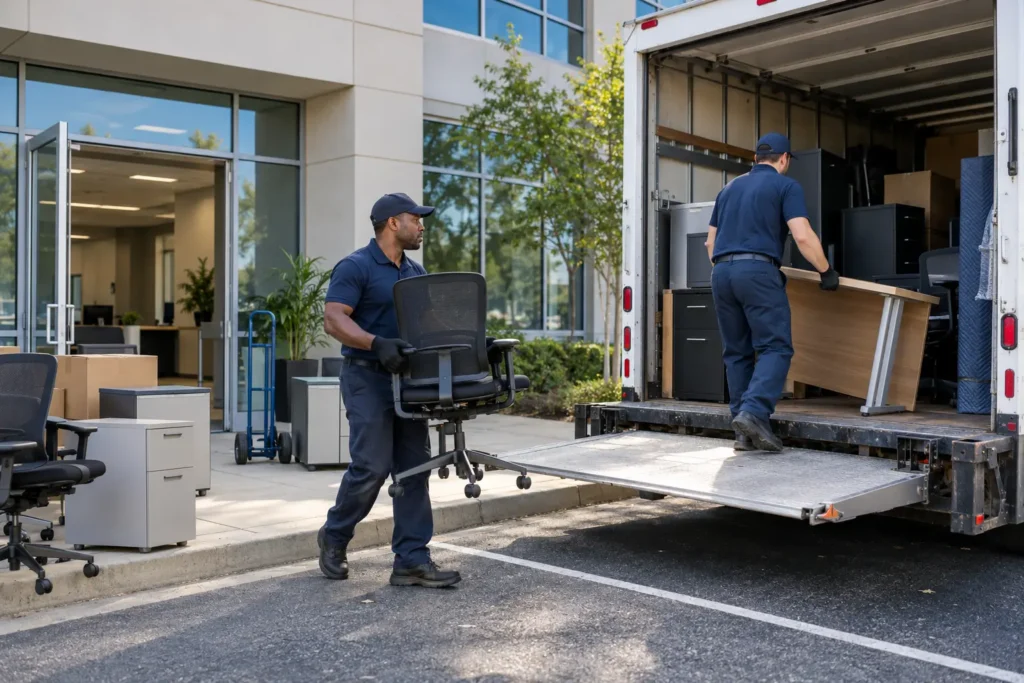
Commercial junk removal for Woodbridge businesses typically includes an upfront assessment, labor, lifting, loading, haul-away, and responsible disposal of approved items. Depending on the project, it may also include furniture disassembly, sorting for donation or recycling, and a basic sweep-up after the removal is complete.
The exact scope depends on what you need removed, how much material there is, where it is located, and how your building can be accessed. An office cleanout on the ground floor is different from clearing furniture out of a multi-story building with elevator reservations, loading-dock rules, or restricted service hours.
That is why a professional commercial removal quote should define what is included before the work begins.
Need to clear unwanted items from a Woodbridge business? Contact DUMPIRE LLC to request a free estimate. Tell us what needs to go, where it is located, and when the space needs to be cleared.
|
Usually included |
Confirm before booking |
Usually requires separate handling |
|
Job assessment and estimate |
Computers and electronics |
Chemicals, fuel, and unknown liquids |
|
Labor and heavy lifting |
Commercial appliances |
Medical waste and sharps |
|
Loading and haul-away |
Dense construction debris |
Asbestos and biohazards |
|
Approved furniture and fixtures |
Oversized or specialty equipment |
Secure document or data destruction |
|
Sorting for appropriate disposal |
After-hours or weekend work |
Regulated hazardous materials |
|
Basic sweep-up of the work area |
Multi-phase or recurring pickups |
Major demolition outside the agreed scope |
This table is a general guide, not a substitute for a project-specific quote. Always identify unusual, hazardous, extremely heavy, or regulated items when requesting an estimate.
Full-service commercial junk removal is more than a truck arriving to pick up a pile at the curb. For approved projects, the crew can handle the physical work from the point of removal through loading and haul-away.
Commercial properties generate many kinds of unwanted material. What can be accepted depends on its condition, weight, composition, and local disposal requirements.
Common examples include:
Do not assume that an item is acceptable simply because it fits in a truck. Tell the provider about electronics, refrigerant-containing appliances, liquids, unusually heavy materials, and construction debris before the appointment.
Commercial removal can support both one-time projects and ongoing property needs.
An office relocation often leaves behind furniture, filing cabinets, shelving, electronics, and supplies that are not moving to the new location. A removal crew can clear approved items while the business focuses on employees, vendors, and move-day logistics.
Retailers may need to remove displays, shelving, damaged inventory, storage-room clutter, or furniture before a remodel, reopening, or lease handoff. Timing is especially important when a new tenant or contractor is waiting for an empty space.
Tenant turnovers can involve abandoned contents, bulky furniture, and accumulated materials. A clearly defined cleanout helps the property manager prepare the unit for inspection, repairs, marketing, or the next occupant.
Renovation work can generate drywall, wood, flooring, cabinets, fixtures, and packaging. Only approved non-hazardous materials should be included, and dense or high-volume construction debris may be priced and handled differently from ordinary commercial junk.
Stockrooms, maintenance areas, and commercial storage spaces can gradually fill with obsolete equipment, damaged furniture, packaging, and items no one has had time to sort. A planned cleanout can recover usable space without turning the job into an employee project.
One of the most important parts of booking commercial junk removal is understanding the limits of the service. Standard removal generally does not include hazardous, biohazardous, or tightly regulated material.
Items that may be excluded or require a specialized provider include:
Sensitive documents and data-bearing electronics deserve special attention. Before a cleanout, remove confidential files and confirm whether computers, hard drives, or other devices require certified data destruction rather than ordinary hauling.
When in doubt, disclose the item before the crew arrives. That makes the quote more accurate and prevents delays on removal day.
There is no single price for every commercial cleanout. A quote generally reflects the actual volume, material, labor, access, and disposal requirements of the project.
The main pricing factors include:
For a more useful estimate, provide photos, an item list, the Woodbridge address or ZIP code, floor and elevator details, parking or dock information, and the date the space must be cleared.
Planning a commercial cleanout? Ask DUMPIRE LLC for an upfront estimate before the removal begins.
1. Describe the project
Share the business type, location, items, approximate volume, access conditions, and deadline. Photos can make the initial conversation more efficient.
2. Confirm building requirements
Check whether the property manager requires a reserved elevator, loading-dock appointment, parking authorization, service-hour restriction, or certificate of insurance. These details should be resolved before the crew arrives.
3. Review and approve the estimate
The estimate should define the approved items and work. If the contents or access conditions change, confirm whether the price or schedule will also change.
4. Mark what stays and what goes
Use clear labels or place keep-items in a separate area. Assign one person who can answer questions and approve decisions during the cleanout.
5. Removal, loading, and haul-away
The crew removes the approved items, loads them, and transports them for donation, recycling, or disposal as appropriate.
6. Final walk-through
Before the crew leaves, inspect the work area and confirm that the agreed items have been removed. This is particularly important for multi-room offices and spaces with both keep and remove items.
Woodbridge businesses operate within Prince William County, where commercial recycling and disposal requirements matter.
According to Prince William County Solid Waste Management, businesses, offices, and commercial facilities must recycle the material that makes up the largest portion of their annual waste stream. The relevant material may vary by business. Mixed paper or single-stream recycling may be important for offices, while corrugated cardboard may be a primary material for retail and warehouse operations.
The county also limits the amount of construction and demolition debris businesses and contractors may bring to the county landfill. Larger loads require an alternative disposal option. Appliances containing refrigerant and other special materials can also have additional requirements. Businesses should review the county’s current disposal guidance or confirm the correct handling route before a project begins.
These local requirements are another reason to identify materials accurately instead of treating every commercial cleanout as general trash pickup.
A little preparation can make a commercial cleanout faster and reduce the risk of mistakes.
Do not place hazardous or undisclosed material inside boxes of general junk. If the crew cannot identify an item safely, the removal may need to stop until the contents are confirmed.
Using employees to manage a cleanout can appear less expensive, but it also takes staff away from their regular work and creates new responsibilities: lifting, truck rental, loading, disposal-site research, transportation, and cleanup.
Full-service removal combines those steps into one coordinated project. It can be especially useful when a business is working toward a lease deadline, preparing for contractors, turning over a unit, or trying to minimize disruption during operating hours.
DUMPIRE LLC provides licensed and insured junk removal for businesses and properties in Woodbridge and across the DMV. Our team offers upfront estimates, handles the heavy lifting for approved items, and looks for appropriate donation or recycling opportunities when practical.
Whether you are clearing a few bulky office items or preparing an entire business space for a move, renovation, or tenant turnover, the first step is defining the scope.
Tell DUMPIRE LLC:
Contact DUMPIRE LLC or call (571) 225-8453 to request a free commercial junk removal estimate for your Woodbridge property.
Do employees need to move the junk outside?
Generally, no. Full-service removal includes carrying approved items from their current location, subject to safe access and the agreed scope. Tell the team about stairs, elevators, long hallways, or restricted areas in advance.
Can a commercial junk removal crew remove office furniture and cubicles?
Desks, chairs, filing cabinets, shelving, and freestanding office furniture can commonly be removed. Cubicles, attached fixtures, and items requiring extensive disassembly should be reviewed before booking.
Can you remove computers and office electronics?
Some electronics may be accepted, but confirm each type before the appointment. Remove sensitive data first or arrange certified data destruction through an appropriate provider.
Is same-day commercial junk removal available in Woodbridge?
Same-day or next-day appointments may be available depending on crew capacity, project size, item type, and building requirements. Larger cleanouts usually benefit from advance planning.
Can removal be scheduled outside normal business hours?
Scheduling options depend on availability and the scope of the project. Share your preferred service window, building restrictions, and deadline when requesting the estimate.
Does the price include labor and disposal?
A commercial estimate should specify the included labor, loading, haul-away, and disposal-related costs for the approved scope. Ask for clarification before approving any quote.
What happens to the items after removal?
The destination depends on the item’s type and condition. Reusable items may qualify for donation, accepted materials may be recycled, and the remainder is taken to an appropriate disposal facility. Donation and recycling cannot be guaranteed for every item.
What materials should be disclosed before booking?
Tell the provider about chemicals, liquids, batteries, electronics, appliances, construction debris, extremely heavy objects, medical items, and anything that may be hazardous or regulated.