Fairfax County residents can recycle electronics for free at the I-66 Transfer Station or the I-95 Landfill Complex, or schedule a free Special Pickup if the county collects their trash directly. Virginia has no law banning electronics from household trash statewide, but the county’s own program, not a state ban, is what actually decides what you can do with an old TV, computer, or monitor.
No. While Virginia has no state law that bans electronics from household trash outright, Fairfax County’s own program routes electronics away from regular trash and bulk pickup and toward two specific channels: a free drop-off at one of two county facilities, or a scheduled Special Pickup. The county’s own Curbside Recycling page states it plainly: electronic waste, including computers, TVs, and cellphones, is not accepted curbside and requires scheduling a Special Pickup instead.
A lot of junk removal content online claims Virginia has a blanket law against trashing electronics, with fines for anyone who does. That’s an overstatement. The actual statute, the Computer Recovery and Recycling Act (Va. Code §10.1-1425.27 through .38), requires manufacturers that sell more than 500 units of computer equipment a year in Virginia to offer customers a free way to return or recycle that equipment. It regulates manufacturers, not what a homeowner does with an old laptop.
There’s a separate statute, Va. Code §10.1-1425.26, that comes closer to a landfill ban, but it’s a local-option law. A locality may adopt an ordinance banning disposal of cathode ray tubes and mercury thermostats specifically in its own solid waste facilities, and even then the law specifies that only the item’s original owner could be penalized under such an ordinance, never a hauler. No blanket statewide “you’ll be fined for trashing a TV” law exists. What actually governs a Fairfax County resident is the county’s own Special Pickup and drop-off system described below, not a state landfill ban.
Clearing out more than just electronics? Our house cleanout service handles a full room or property in one visit instead of sorting disposal routes item by item.
No. Electronics are explicitly excluded from curbside trash and bulk pickup in Fairfax County. They require either a scheduled Special Pickup or a self-haul drop-off at one of the county’s two facilities.
This is the detail most guides skip entirely. Fairfax County’s own pages state that approximately 10% of residents receive trash and recycling collection services directly from Fairfax County Government. The other roughly 90% use a private, county-permitted hauler, and questions about that service go to the private provider directly, not the county. If you’re not sure which group you’re in, the county’s own tool, “Does Fairfax County Pick Up My Trash?”, settles it.
This matters because the Special Pickup program described next applies directly to county collection customers. If you use a private hauler, your provider sets its own rules for electronics, which likely resemble the county’s but aren’t guaranteed to be identical. Either way, both groups can use the two free drop-off facilities covered further down, since those aren’t tied to which collection service you use.
County collection customers get 5 free special collections per fiscal year (July 1 through June 30), and electronic waste is one of five accepted categories alongside Freon, brush and limbs, bulk material, and metal. You have to schedule these in advance rather than just setting items at the curb.
Special Pickups are limited to 2 cubic yards, roughly 6 feet long by 3 feet wide by 3 feet high, and a charge applies to anything larger than that. Items go out at the curb or street line, with 20 feet of clearance above and on all sides, and not under utility wires or tree branches.
Here’s the detail that trips people up most. Fairfax County’s own Special Pickup instructions state it directly: “Please do not include broken electronics as part of an E-waste pickup. Broken electronics should be put out with your regular trash.” In other words, a working TV or computer that’s simply outdated goes through the E-waste Special Pickup category and gets disassembled for parts recycling. A broken one goes out with your ordinary household trash instead. It’s a small distinction, but getting it backward is exactly the kind of thing that leads to a missed pickup.
As of this writing, the county has also posted a notice that Special Pickup service is experiencing delays, with instructions to leave items at the curb until they’re collected. Check the county’s current recycling and trash notices before assuming a specific turnaround time.
Handling electronics as part of a bigger clearout, garage, basement, or a whole property? Our garage cleanout service removes everything in one visit instead of separating it into county pickup categories yourself.
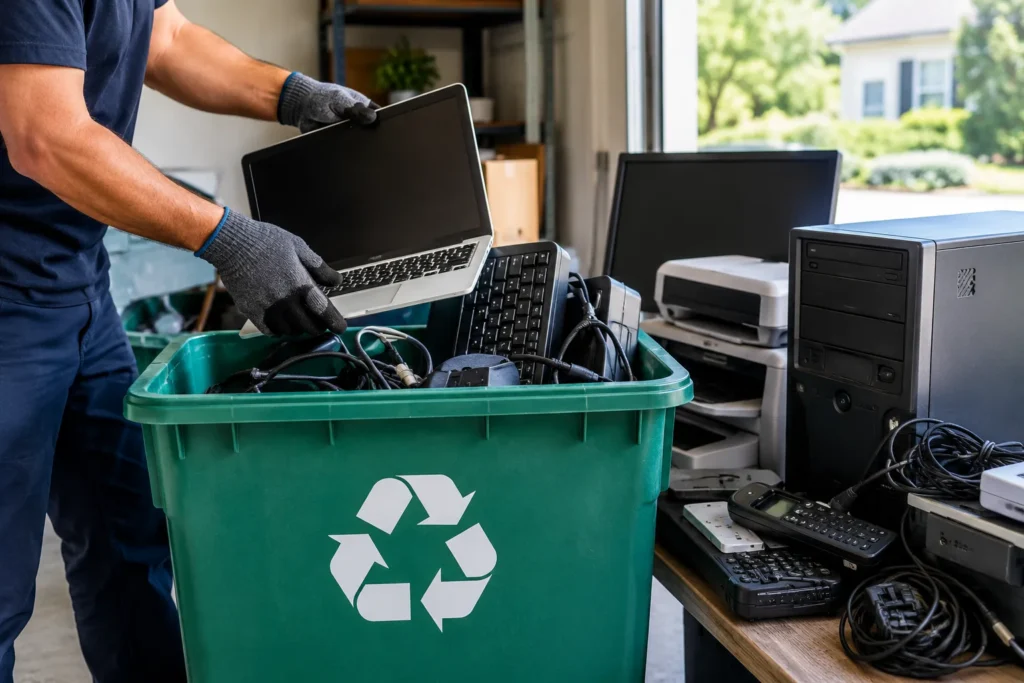
Fairfax County operates two facilities where residents can self-haul electronics for free, up to a maximum of 10 large items per visit (think TVs, printers, scanners, and computers).
| Facility | Address | Electronics Hours |
| I-66 Transfer Station | 4618 West Ox Rd, Fairfax | Open 6 days, closed Wednesday. Mon 7a-5p, Tue 12p-5p, Thu 12p-5p, Fri 7a-5p, Sat 7a-4p, Sun 7a-4p |
| I-95 Landfill Complex | Lorton, VA | Open 2 days only: Wed 7a-5p and Sat 7a-4p. Closed Mon, Tue, Thu, Fri, Sun |
Both facilities accept computers, TVs, monitors, cell phones, and miscellaneous cables, and both flatly state that drop-off after posted hours isn’t permitted. Note the I-95 Landfill Complex runs on a much narrower schedule than I-66, so a Saturday trip is really your only overlap day if you can’t make a Wednesday.
Proof of Fairfax County residency may be required at either site. The county accepts a driver’s license, a state ID card, a property tax bill, or a utility bill as proof. This program serves residents only, businesses, nonprofits, and other organizations aren’t eligible for the free residential drop-off.
One more thing worth knowing before you drive out: the county has announced a permanent entrance closure at the I-95 Landfill Complex’s Furnace Road entrance in October 2026. If you’re planning a trip to that facility, check the county’s current site notices for the latest access details rather than relying on older driving directions.
Yes. eAsset Solutions, a certified electronics recycler in Falls Church, offers free drop-off recycling with no appointment necessary for most items, an option worth knowing about if neither county facility’s schedule works for you or you’re closer to Falls Church than to Fairfax or Lorton.
Most items, including computers, laptops, hard drives, printers, and cell phones, are free. A few categories carry a fee: flat monitors run $5 per unit, CRT monitors and all televisions are $1 per inch of screen, and mixed media like CDs and VHS tapes cost $0.50 per unit after the first 10 are free. Drop-off hours run Monday through Friday, 10 a.m. to 5 p.m., and Saturday, 10 a.m. to 2 p.m., closed Sundays and holidays. A free certificate of recycling and data destruction is available on request.
Best Buy is another retailer take-back option worth knowing: most items are free, TVs 32 inches and larger cost $29.99, and there’s a 3-item-per-day limit at in-store drop-off. Between the three options, county facilities are free across the board but run on a limited weekly schedule, eAsset Solutions adds a small fee for TVs and monitors but needs no appointment and offers on-the-spot data destruction, and Best Buy works well for a single item on a day the county sites are closed.
If electronics are just one part of a bigger cleanout, sorting between three different drop-off options can eat up more time than the disposal itself. Our Fairfax junk removal service can pick up electronics alongside furniture, appliances, and everything else in a single visit.
Yes, if they still work. Donation keeps a device in use rather than sending it to recycling, though the options are more limited than they are for furniture or clothing. None of the recycling points covered above function as donation centers, they’re disposal and recycling channels, not reuse organizations, so a working laptop or monitor is generally better routed to a local nonprofit, school program, or an online marketplace listing than to a county drop-off site.
Whatever route you choose, wipe the device fully before handing it off. A factory reset alone isn’t considered sufficient for a device that stored personal data.
Before any electronic device leaves your hands, whether it’s headed to a county facility, a private recycler, or a donation drop-off, take two steps. First, delete all personal information from the device, and for anything with a hard drive, understand that a simple factory reset doesn’t fully erase stored data, a dedicated wipe tool or physical drive removal is the safer route. Second, remove any batteries, since Fairfax County’s own guidance notes they may need to be recycled separately from the device itself.
No program covered in this guide, county or private, takes responsibility for data left on a device you hand over. That responsibility stays with you.
Sorting county drop-off hours, Special Pickup scheduling, and private recycling fees takes real time, especially if electronics are just one part of a larger cleanout. Dumpire LLC can pick up electronics along with furniture, appliances, and everything else you’re clearing out, often the same day, without you needing to plan multiple trips.
Dumpire LLC
McLean, VA
Phone: (571) 225-8453
Find us on Google Maps: https://maps.app.goo.gl/81SvenWW1Jb3FuJ38
Q1: Is it illegal to throw electronics in the trash in Virginia?
Not under a single statewide law. Virginia’s Computer Recovery and Recycling Act requires manufacturers to offer free take-back options, and a separate statute allows (but doesn’t require) localities to ban certain items like CRTs from their own landfills. Fairfax County’s actual rule is its own Special Pickup and drop-off program, not a blanket state ban.
Q2: Does waste management pick up old electronics in Fairfax County?
Only through a scheduled Special Pickup if you’re a county collection customer, and only for working electronics, broken ones go out with regular trash instead. Electronics are never accepted with ordinary curbside trash or bulk pickup.
Q3: How can I schedule a Special Pickup in Fairfax County?
County collection customers request one through the county’s Special Pickup page before setting items at the curb. Items must be scheduled in advance rather than left out unannounced, and the pile is limited to 2 cubic yards.
Q4: Does Best Buy still recycle electronics for free?
Yes, for most items. TVs 32 inches and larger carry a $29.99 fee, and drop-off is limited to 3 items per household per day.
Q5: What happens to electronics after they’re recycled in Fairfax County?
Most are disassembled, with parts sorted by material and sold on the recyclables market. Hazardous components, like leaded glass in older monitors, are removed and sent to a permitted hazardous waste facility for proper handling.
Q6: Can I recycle a broken TV or computer the same way as a working one?
At the two county drop-off facilities, yes, both working and non-working electronics are accepted there. It’s specifically the Special Pickup curbside program where the distinction matters: broken electronics are excluded from that category and go out with regular trash instead.
Q7: Do I need an appointment to drop off electronics in Fairfax County?
No appointment is needed at either county facility during posted hours, though a Special Pickup for curbside collection does need to be scheduled in advance. eAsset Solutions in Falls Church also requires no appointment except for large quantities or witnessed data destruction.
Q8: What’s the difference between the I-66 Transfer Station and the I-95 Landfill Complex for electronics?
Both accept electronics free for residents, but on very different schedules. I-66 is open 6 days a week (closed Wednesday), while I-95 accepts electronics only on Wednesday and Saturday. If your week doesn’t include a Wednesday trip, I-66 gives you far more flexibility.