Appliance disposal in Fairfax County is free when you schedule it and costs money when you don’t. A county collection customer who books a Special Pickup gets a refrigerator, freezer, or air conditioner hauled away at no charge, up to five times a fiscal year. Haul that same appliance to a county facility yourself and you’ll pay a flat $15 White Goods fee per item, no scale required.
It depends entirely on which route you take, and the two routes land on opposite ends of the price scale. Schedule a curbside Special Pickup through Fairfax County and a Freon-containing appliance goes out free, as long as you’re a county collection customer and you still have special collections left in your annual allowance of five. Load the same refrigerator into a truck and drive it to a self-haul facility yourself, and the county charges a flat $15 White Goods fee, no scale, no exceptions.
That $15 figure and the free scheduling option both come from Fairfax County’s own Residential Disposal Fees and Regulations page, which lists White Goods (anything that requires refrigerant removal or contains a capacitor, including refrigerators, freezers, humidifiers, dehumidifiers, water coolers, and air conditioners) at $15 each. The county doesn’t publish this contrast anywhere as a single “schedule instead of hauling” tip, which is exactly why so many residents assume disposal costs money no matter what.
One practical wrinkle worth flagging before you plan a self-haul trip: Fairfax County’s I-95 Landfill Complex has a permanent closure at its Furnace Road entrance effective Saturday, October 10, 2026. If you’re heading to I-95 rather than the I-66 Transfer Station, check the county’s current site notices before you drive out, since an access change like this can derail a trip that worked fine last month.
And here’s the part that trips up most residents searching for an answer: roughly 90% of Fairfax County households don’t get trash service directly from the county at all. They’re on a private hauler or an HOA-arranged contract, which means the free Special Pickup program simply isn’t available to them. If you’re not sure which group you’re in, your trash bill or your HOA’s waste contract will tell you. Residents outside the county program still have the $15 self-haul option at the county facilities, since that side of the system isn’t tied to collection-customer status.
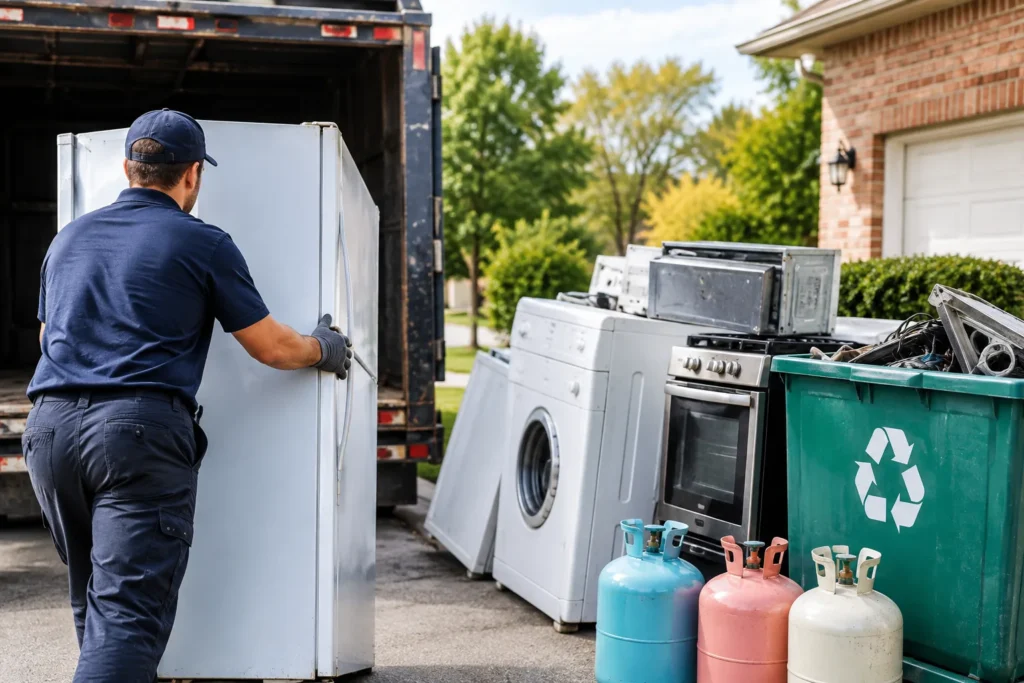
A refrigerator or air conditioner costs more to dispose of than a stove or washer because it contains refrigerant, and federal law requires that refrigerant be removed and recovered before the appliance can be scrapped. That one difference, refrigerant versus no refrigerant, is the entire reason Fairfax County splits appliances into two separate categories with two separate rules.
Section 608 of the Clean Air Act requires certified technicians to recover refrigerant from any appliance that contains it before the unit is disposed of or recycled. This isn’t a Fairfax County rule or a hauling company’s add-on fee. It’s federal environmental law, which is why the handling (and the pricing) differs from an ordinary stove or dryer that never held refrigerant in the first place.
Fairfax County’s own Special Pickup program reflects that split directly. The Freon category covers refrigerators, freezers, dehumidifiers, and air conditioners, the appliances that actually need refrigerant recovery. A separate Metal category covers stoves, washers, dryers, water heaters, metal shelves, bedframes, metal fencing, grills without propane tanks, and exercise equipment. Both categories are free through Special Pickup and both count against the same five-collections-per-fiscal-year allowance, but they’re tracked and processed differently because only one of them involves a federally regulated gas.
There’s a smaller distinction worth knowing if you’re self-hauling instead of scheduling a pickup. The self-haul White Goods fee list is slightly broader than the Special Pickup Freon list. It adds humidifiers and water coolers, two items that don’t appear on the curbside Freon list at all. If you’re trying to get rid of a water cooler specifically, don’t assume Special Pickup covers it the way it covers a refrigerator. It doesn’t.
Appliances aren’t the only category with its own rulebook. Electronics like TVs, monitors, and computers follow a completely different Fairfax County program with separate drop-off rules, which Dumpire covers in a dedicated guide to Fairfax County’s e-waste rules if you’re clearing out both at once.
You schedule a free Special Pickup online at specialpickup.fairfaxcounty.gov or by calling the county’s Customer Service Center at 703-802-3322. Either method confirms your pickup date, and the five-collection fiscal-year allowance resets every July 1.
Once it’s scheduled, set the appliance at the curb or street line by 6 a.m. on the collection day, with at least 20 feet of clearance and nothing blocking it under utility wires or tree branches. Keep the pile under 2 cubic yards (roughly 6 feet by 3 feet by 3 feet). Go over that and the county adds an extra charge even within the free program, which defeats the purpose of scheduling in the first place.
The eligibility catch is the same one that trips up the free-vs-fee question above: Special Pickup is only available to county collection customers, the roughly 10% of Fairfax County residents whose trash service comes directly from the county rather than a private hauler or an HOA contract. If you’re not sure which group you fall into, the scheduling site will tell you when you try to book, and it’s worth checking before you plan around a free pickup that might not apply to your address.
Fairfax County’s Special Pickup program accepts exactly five categories of material: Freon, brush and limbs, bulk material, electronic waste, and metal. Anything that doesn’t fit one of those five categories gets left behind, no matter how it’s packaged or how it looks sitting at the curb.
The county states this plainly: no cardboard, no plastic bags, no construction debris, and no item that isn’t on the accepted-materials list. That last part matters more than it sounds. An appliance mixed in with a pile of renovation debris, or set out in a cardboard box, risks the whole pile getting skipped rather than partially collected.
A few other restrictions apply specifically to appliances. Propane tanks are explicitly excluded from the Metal category, even when they’re attached to a grill being thrown out, and have to go to a Household Hazardous Waste site instead. Items longer than 6 feet or piles that exceed the 2 cubic yard limit incur an extra charge even through the normally free Special Pickup program. And self-haul facilities require proof of Fairfax County residency, so this isn’t a program businesses, nonprofits, or non-residents can use, even if they’re willing to pay the $15 fee.
If you’re not a Fairfax County resident but you’re dealing with an appliance in a county that borders Fairfax, be careful not to mix up jurisdictions. The City of Fairfax is a separate, independent city government with its own trash rules, distinct from Fairfax County itself, and nearby cities like Falls Church run their own fee schedules that don’t apply here. If you’ve seen a different appliance fee quoted online for a “Fairfax” address, check whether that source is actually talking about Fairfax County before assuming it applies to you.
A working appliance is almost always worth donating before you dispose of it, since Fairfax County’s own waste-reduction guidance puts reuse ahead of recycling, but donation groups enforce real limits on condition and age that disqualify more appliances than people expect.
Habitat for Humanity ReStore is the most commonly cited donation option for larger appliances in the area, with locations in Chantilly and Alexandria that accept drop-offs or, in some cases, pickup. Their rules are specific rather than vague: an appliance generally needs to be less than 10 years old with no rust, dishwashers have to be 5 years old or newer, and wall ovens aren’t accepted at all. If your refrigerator is older than that or showing rust along the seams, it’s headed for recycling rather than a new home, no matter how well it still runs.
Smaller appliances have more flexible outlets. Goodwill takes smaller working items, and groups like GreenDrop operate as additional donation drop-off points in the area. None of this replaces the Freon recovery requirement covered above. A donated refrigerator still needs its refrigerant handled correctly by whoever eventually retires it, that part of the law doesn’t disappear because the appliance changed hands.
The right choice depends on what you have available: time, a vehicle, and how many items need to go. Each option trades one of those for the others.
Self-hauling makes sense if you have a vehicle that can handle the weight, the physical ability to lift the appliance yourself, and you don’t mind a facility trip. It costs $15 per Freon appliance and gets the job done the same day you decide to do it, no scheduling lead time required.
Scheduling a Special Pickup makes sense if you’re a county collection customer with enough advance notice to plan around a set pickup date. It’s free, but it requires planning within your five-collection annual allowance, and it only works for the roughly 10% of residents eligible for it.
Hiring a private company makes sense when speed, heavy lifting, or multiple items are the priority. Local pricing guides circulating online put small-appliance removal in the neighborhood of $99 and up, with refrigerators and freezers often running higher, though those figures vary by company and job and shouldn’t be treated as a fixed rate. If you’re already clearing out a garage or a kitchen remodel and the appliance is just one item among several, a full appliance removal service in McLean can handle the whole job, including the Freon appliance, in one trip instead of splitting it across county scheduling and a separate hauling run.
Whichever route fits your situation, it helps to know your coverage area ahead of time. Dumpire’s coverage area across Northern Virginia includes Fairfax along with the surrounding communities, so you’re not guessing whether same-day help reaches your address.
Scheduling a Fairfax County Special Pickup gets a Freon appliance hauled away for free. Self-hauling the identical appliance to a county facility costs a flat $15. Non-Freon appliances like stoves and washers are free either way through the Metal category. Beyond cost, remember the restricted-items rule (only five categories are accepted, nothing else) and consider donation first if the appliance still works and meets the age and condition limits. If none of that fits your timeline, the team at Dumpire can take care of it directly.
If scheduling a county pickup, hauling to a facility yourself, or sorting out which category your appliance falls into sounds like more hassle than it’s worth, Dumpire LLC handles the whole job directly, Freon appliance included, without you having to plan around a five-collection annual limit.
Dumpire LLC
McLean, VA
Phone: (571) 225-8453
Find us on Google Maps: https://maps.app.goo.gl/81SvenWW1Jb3FuJ38
Q1: What is the phone number to schedule a Special Pickup in Fairfax County?
Fairfax County’s Customer Service Center handles Special Pickup scheduling at 703-802-3322 (TTY 711). You can also schedule online without calling at all.
Q2: Will a waste management company take old refrigerators?
It depends on which kind of waste management you mean. If you’re a Fairfax County collection customer, a scheduled Special Pickup takes refrigerators for free. If you’re on a private hauler or HOA contract instead, that company sets its own rules and pricing for appliance pickup, separate from the county program.
Q3: Does Fairfax County pick up refrigerators curbside automatically, without scheduling?
No. Curbside collection of a refrigerator or any other Freon appliance only happens after you schedule a Special Pickup in advance. Nothing gets picked up automatically just because it’s sitting at the curb.
Q4: What happens to an appliance after it’s recycled in Fairfax County?
The refrigerant gets recovered first, as required by federal law, and the remaining metal shell goes through standard scrap metal recycling. The appliance isn’t simply thrown into a landfill as a single unit.
Q5: Can a business use the free Special Pickup or the $15 self-haul rate?
No. Both the free Special Pickup program and the self-haul facility pricing are residential programs. Self-haul facilities specifically require proof of Fairfax County residency, which rules out businesses, nonprofits, and non-residents regardless of whether they’re willing to pay.
Q6: Is the City of Fairfax the same as Fairfax County for trash and appliance rules?
No, they’re two separate jurisdictions with their own trash systems. The City of Fairfax is an independent city with its own rules, while everything covered in this guide applies specifically to Fairfax County. If you’re not sure which one applies to your address, check your local government’s website directly rather than assuming the two are interchangeable.