Compassionate hoarding cleanup help in Woodbridge, VA means pairing emotional support with practical steps: connecting with a people-first resource like the Hoarding Alliance, sorting room by room instead of all at once, and knowing how Prince William County’s trash rules actually work before you haul anything. The word “compassionate” shows up on almost every hoarding cleanup page you’ll find searching this area. What makes it real is whether the page backs that word up with something you can actually use.
In practice, compassionate hoarding cleanup means removing pressure and judgment from the process while still giving the household a clear, workable plan. It’s not a tone or a tagline. It’s whether the people involved get to keep control over their own belongings and their own pace.
Search for hoarding cleanup help in Woodbridge and you’ll notice the same word everywhere. Restoration companies, junk haulers, and specialty cleaners all lead with “compassionate” in the first sentence of their homepage. That’s not a coincidence, and it’s worth saying plainly: the word itself has become table stakes in this niche. Nearly every company serving Prince William County uses it. On its own, it tells you almost nothing about what the company actually does differently.
What separates a genuinely compassionate approach from a marketing word is whether it’s paired with something concrete. A real local resource that isn’t trying to sell you anything. A sorting method that doesn’t force snap decisions on every item in a house. A straight answer about disposal rules instead of vague reassurance. Even something as basic as how a cleanout process is actually structured, step by step, does more to earn trust than the word alone ever could. That’s the standard this guide holds itself to: every time “compassionate” shows up below, it’s attached to something specific, not floating on its own.
That starts with the fact that cleanup is only one half of this. The other half is support, and that’s worth covering before a single box gets sorted.
The clearest starting point is the Hoarding Alliance, a people-first initiative built around the idea that the person comes before the stuff. It’s not a cleaning company and it’s not selling a service. It exists to give people and families a judgment-free place to begin, whether that means a caring conversation about safety and next steps, practical organizing help at home, or ongoing peer support that doesn’t require a diagnosis or a commitment to therapy.
That last distinction matters. The Hoarding Alliance is explicit that what it offers is peer support and education, not clinical treatment or emergency services. For a lot of families, that’s exactly the right level of support: a place to talk honestly about what’s happening in a Woodbridge home without it immediately becoming a medical or legal process. If the situation does involve a safety risk, a structural issue, or something that genuinely needs professional intervention beyond peer support, that’s a different conversation, and it’s one worth having before a cleanup date gets scheduled.
Support like this works best running alongside the physical cleanup, not after it. Knowing there’s somewhere to turn for the emotional side of the process makes the practical side, the part covered in the rest of this guide, considerably less overwhelming to start.
The most workable approach is sorting one room at a time into four categories: keep, donate, trash, and unsure, rather than trying to make a decision about every single item in the house at once. Trying to sort a whole home in one pass is the single biggest reason cleanouts stall before they’re finished, because every item becomes its own ten-minute negotiation.
Pick a room with a clear, practical use to start, a kitchen, a bathroom, a hallway closet, not the bedroom with the most sentimental weight attached to it. Starting with the hardest room first is where most self-directed cleanouts lose momentum. Save that room for once you’ve already built some progress elsewhere in the house.
| Pile | What goes here | Why it helps |
| Keep | Items in daily or regular use | Stays in the home, gets stored properly instead of buried |
| Donate | Usable items the household doesn’t need | Routed to drop-off or scheduled pickup instead of landfill |
| Trash | Damaged, expired, or unusable items | Set aside for bagging and scheduled disposal |
| Unsure | Anything that causes real hesitation | Set aside in its own space, revisited once the room is fully sorted |
The “unsure” pile is doing more work than people expect. Forcing a decision on a hesitant item in the moment slows the whole room down. Set it aside, finish sorting everything else, then come back to the unsure pile with fresh eyes. Most of those items get decided quickly on the second pass, once they’re not competing with forty other decisions at the same time.
This same room-by-room approach is what we walked through in more detail for a Manassas household in our guide on where to start a hoarder cleanout, including a safety walkthrough that applies just as directly to a home in Woodbridge. Once a room is sorted, the trash pile turns into a logistics question, and that’s where Woodbridge and the surrounding county work differently than you might expect.
Woodbridge sits in unincorporated Prince William County, and the county does not provide curbside trash or recycling collection at all, nor does it supply bins. That’s true whether the address is in Woodbridge proper, Dale City, Lake Ridge, Occoquan, or Dumfries. Residents either haul their own trash and recycling to the Landfill and Compost Facility, use one of the Saturday drop-off sites at Nokesville Elementary School or Evergreen Fire Station, or contract directly with a private permitted hauler, according to the county’s Refuse and Recycling Collection page, revised June 18, 2025.
That’s a meaningfully different setup than a lot of households expect, especially if you’re used to a city running its own weekly curbside pickup. There’s no truck coming by on a schedule. The county does not regulate hauler fees either, so pricing and availability vary by which permitted company a household chooses to work with.
For a hoarder cleanout specifically, this changes the math on volume. A cleanout that produces a dozen bags, several pieces of furniture, and a few carloads of donations isn’t something most households can move through a single landfill trip or a single Saturday drop-off slot. Communities like Belmont Bay and Rippon Landing in Woodbridge also have their own HOA or management guidance on bulky-item placement and loading access, so it’s worth checking with the property’s management before setting anything out, separate from the county’s rules entirely.
This is one of the more overlooked parts of planning a cleanout in this area. Knowing the county won’t haul it away for you, and that volume has to be planned around landfill trips, drop-off windows, or a private hauler, is the kind of detail that saves a wasted trip and a frustrated afternoon.
Family-led sorting works well for light to moderate clutter with no safety risk and no hard deadline. Bringing in a professional crew makes more sense once there’s a real volume problem given Prince William County’s lack of curbside pickup, a safety concern, or the sort has already stalled for more than a session or two.
| Factor | Family-led DIY works | Professional makes more sense |
| Safety | No structural damage, mold, pests, or biohazard material | Any of the above are present, or you’re unsure |
| Time | Flexible timeline, no sale or move-out deadline | A closing, move, or inspection date is approaching |
| Disposal | Volume fits a landfill trip or two, or a Saturday drop-off | Volume is too large for the county’s no-curbside setup to handle quickly |
| Progress | The sort is moving forward session to session | The same room has been revisited multiple times with no real progress |
Those factors stack. A household with no safety risk but a large volume of items and no realistic way to make enough landfill trips before a move-out date is often better served by a crew that can clear the volume in days rather than weeks. On the other hand, a smaller amount of clutter with no deadline and no hazard is genuinely a reasonable project for a family to handle on their own, at their own pace, with the four-pile method above.
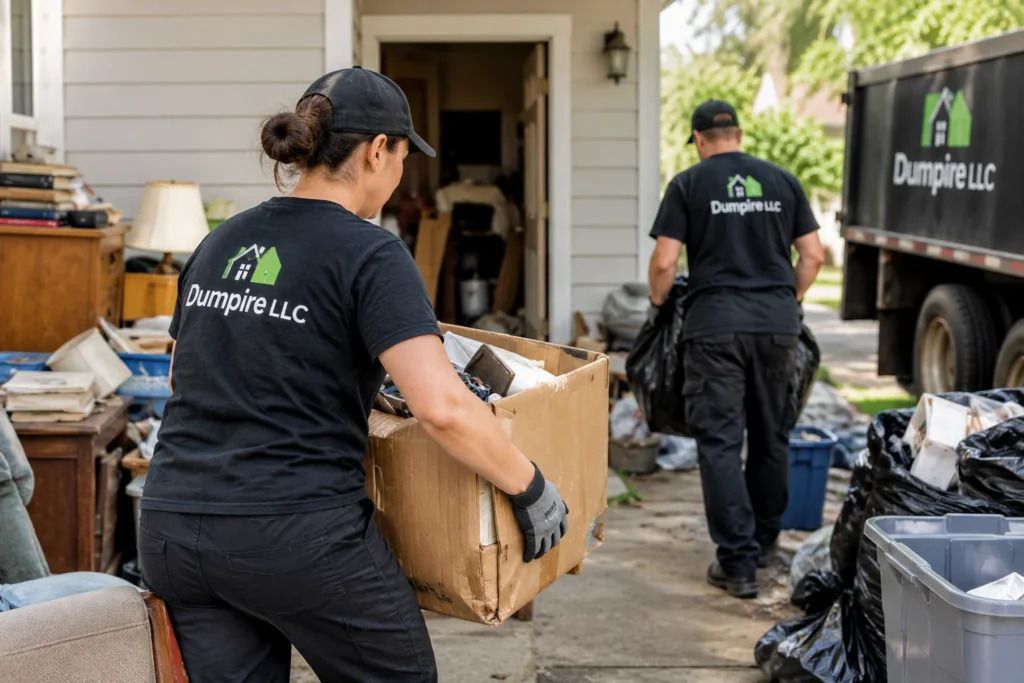
The honest answer for most households in Woodbridge sits somewhere in between: family and friends handle the sorting decisions, since nobody else should be making those calls, and a professional crew handles the hauling and disposal logistics that the county’s no-curbside-pickup setup makes genuinely difficult to manage solo. Dumpire’s hoarder cleanout service is built around exactly that split: the household keeps every keep-or-remove decision, and the crew handles the lifting, loading, and disposal once those decisions are made.
The cleanup itself is only half the work. Without a plan for what comes next, a cleared space can fill back up within months, and that’s a real pattern worth planning around rather than being surprised by.
A few habits make a measurable difference. A short weekly check-in, even just ten minutes walking through the home, catches new accumulation while it’s still small enough to deal with in one pass. Designating one consistent spot for incoming mail and packages stops the single most common entry point for new clutter: paper and boxes that never get a home and slowly spread across counters and tables. And it’s worth deliberately revisiting that “unsure” pile from the original sort on a set schedule, say once a month, rather than letting it quietly become permanent storage for things nobody ever decided about.
This is also where ongoing peer support earns its place. A resource like the Hoarding Alliance’s Unburied program offers a judgment-free way to stay connected to support between major decisions, not just during an initial crisis. Aftercare isn’t a sign the first cleanout failed. It’s the part of the process that determines whether it sticks.
Compassionate hoarding cleanup help in Woodbridge means a few specific things working together: a real support resource for the emotional side, a room-by-room sorting method that doesn’t force every decision at once, a clear understanding of how Prince William County’s no-curbside-collection rules affect disposal, and a plan for what happens after the cleanup ends so the progress actually holds. The word “compassionate” is everywhere in this search. What matters is whether the page behind it gives a household something they can actually use.
If the sort has stalled, the volume is more than a landfill trip or two can handle, or a deadline is approaching, a same-day assessment takes the guesswork out of what’s left. Dumpire’s crew handles the lifting, hauling, and disposal so the household can stay focused on the decisions that actually need a person’s judgment, not a truck’s.
Request a confidential cleanout estimate, or call the number below to talk through the situation before committing to anything.
Dumpire LLC
McLean, VA
Phone: (571) 225-8453
Find us on Google Maps: https://maps.app.goo.gl/81SvenWW1Jb3FuJ38
Q1: Is hoarding cleanup help confidential?
Yes. A reputable cleanup crew works discreetly, using unmarked vehicles where requested and keeping the project between the household and the crew. The same goes for support resources like the Hoarding Alliance, which is built specifically around a no-judgment, private starting point.
Q2: Do cleanup crews handle hazardous materials?
Standard junk removal and hoarder cleanout services are not equipped for active biohazards: human or animal waste, needles, severe mold, or chemical hazards. Those situations need a specialist in biohazard remediation first. A junk removal crew can usually step in once that specialized work is done.
Q3: How long does a hoarding cleanup take?
It depends heavily on square footage, volume, and how the disposal logistics work out given Prince William County’s lack of curbside pickup. A single room might take an afternoon. A full house with years of accumulation can take several weeks for a family working alone, or just a few days with a professional crew handling the hauling and the landfill or drop-off trips.
Q4: Will I be judged for the condition of my home?
No, not by a resource or a crew that’s actually built around a people-first approach. The entire point of compassionate hoarding support, done right, is removing judgment from the process so the household can focus on decisions instead of shame.
Q5: What’s the difference between hoarding cleanup and regular junk removal?
Regular junk removal is usually a single scheduled pickup of items the household has already decided to get rid of. Hoarding cleanup involves the sorting process itself: working through accumulated belongings room by room, protecting important items, and making keep-or-remove decisions along the way, often over multiple visits rather than one.
Q6: What’s the difference between hoarding cleanup and biohazard cleanup?
Hoarding cleanup addresses clutter and accumulated belongings. Biohazard cleanup addresses active health hazards like bodily fluids, severe mold, or contamination, and requires specialized certification and equipment that standard junk removal crews don’t carry. A home can need one, the other, or both, and that’s something a safety walkthrough at the start of the project should identify.