Garage cleanout season in Fairfax County lines up with the county’s Special Pickup calendar: five free collections per fiscal year for residential collection customers. Sorting into keep, donate, haul, and hazardous piles before you schedule a pickup is what decides whether the job costs nothing or turns into a paid haul. Sort first, then schedule, that’s the order that saves both time and money.
Yes, in the sense that actually matters for planning one. Special Pickup’s allowance of five collections resets every July 1, so a cleanout scheduled late in the fiscal year (spring) is competing with whatever’s left of that year’s five, while one scheduled right after the reset has the full allowance available.
That’s the verified mechanic, and it’s worth being precise about what it does and doesn’t mean. Fairfax County doesn’t publish seasonal demand data, so there’s no county source saying garage cleanouts specifically cluster in fall or spring. What’s verified is the calendar itself: the reset date, and the fact that five pickups is the hard cap for the year regardless of when you use them. If you’ve already used three Special Pickups on other projects this fiscal year, a garage cleanout in May is working with two, not five.
There’s a jurisdiction wrinkle worth knowing before you plan around any of this. If you live in Herndon, the town runs its own separate Fall Clean-up collection in October, distinct from Fairfax County’s Special Pickup program. The two don’t share an allowance, and scheduling one doesn’t use up the other. It’s a different kind of mix-up than the City of Fairfax versus Fairfax County confusion that trips up a lot of residents on trash questions generally. Town programs, county programs, and city programs are each their own system with their own rules, so it’s worth confirming which one actually applies to your address before you count on either.
If you’re not a Fairfax County collection customer at all, maybe you’re on a private hauler or an HOA waste contract, none of this Special Pickup timing applies to you, and the garage cleanout service page is the more direct option since there’s no free allowance to plan around in the first place.
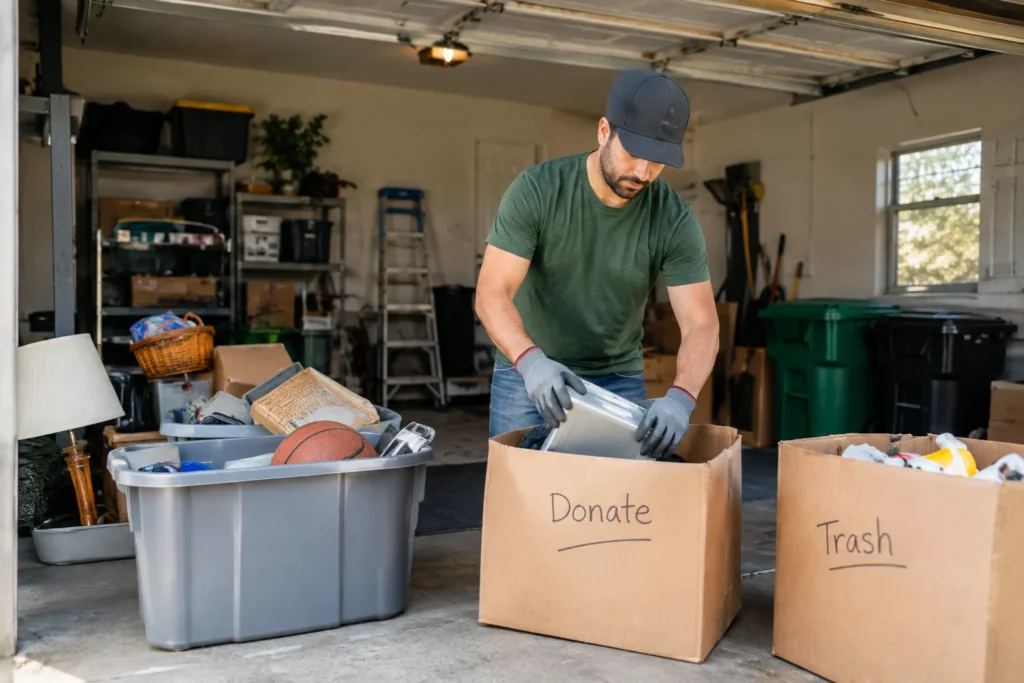
Four piles, sorted in that order: Hazardous first, then Keep, Donate, and Haul. Setting the hazardous pile aside first matters because it can’t go out with any of the other three, not with Special Pickup, not with regular trash, and not in a donation drop-off.
Once hazardous items are pulled aside, the other three piles move fast if you’re strict about the rule for each:
Keep is anything you’ve actually used in the last two years, not something you’re keeping “in case.” If you can’t remember the last time you touched it, it’s not a keep.
Donate is working tools, usable sports equipment, and functional furniture, nothing damp, moldy, cracked, or missing parts. A donation center can’t move items that need repair first.
Haul is everything else: broken, obsolete, or just unwanted. This is usually the biggest pile in a garage that hasn’t been sorted in a few years.
This four-pile approach is the same basic structure a full garage cleanout service runs on, just compressed into a pickup-day timeline instead of a full-service visit. If the project is bigger than a weekend sort, the garage cleanout page covers the complete process and pricing factors for a crew handling the whole thing, lifting and loading included.
Special Pickup covers five categories: Freon appliances, Metal, Bulk Material, Brush and limbs, and Electronic waste. A typical garage cleanout usually touches three of the five: Bulk Material almost always, Metal often, and Freon occasionally if an old mini-fridge or window air conditioning unit is involved.
Here’s what actually qualifies in each garage-relevant category, based on Fairfax County’s own Special Pickup program:
| Category | Accepted garage items | Cost |
| Bulk Material | Sofas, chairs, tables, dressers, mattresses and box springs, lumber, doors, rolled carpet under 6 feet, wood pallets, bamboo | Free up to 2 cubic yards via Special Pickup |
| Metal | Metal shelving, bed frames, metal fencing, grills (no propane tanks attached), exercise equipment | Free via Special Pickup |
| Freon | Refrigerators, freezers, dehumidifiers, window air conditioning units | Free via Special Pickup, or $15 self-haul |
Two limits apply across every category: a pile can’t exceed 2 cubic yards, roughly 6 feet long by 3 feet wide by 3 feet high, and no single item can be longer than 6 feet. Go over either one and the county charges extra, even within an otherwise free pickup.
Since mattresses and box springs fall under Bulk Material, a garage cleanout that’s mostly about clearing out an old mattress and frame is worth handling as its own project. If that’s the specific job, our mattress recycling guide breaks down the free-versus-paid options in more detail than fits here.
Paint, solvents, motor oil, pesticides, propane tanks, and car batteries can’t go out with Special Pickup or regular trash at all. Fairfax County residents can drop these off for free at the I-66 Transfer Station or the county’s Recycling and Disposal Center at the I-95 Landfill Complex in Lorton, with proof of residency required (a driver’s license, state ID, property tax bill, or utility bill all work).
Paint is where this trips people up most. Fully dried, solid latex paint can usually go in regular household trash, nothing to drop off. Oil-based paint, stain, and solvent-based products are a different story: they’re treated as hazardous waste even after they’ve dried, and they need to go to a drop-off site rather than the trash can. It’s a distinction that’s easy to miss if you’re sorting quickly, and getting it wrong means a bag of “dried paint cans” that your regular collection won’t take.
The full accepted list at Fairfax County’s household hazardous waste program is broader than most garages need, but the items that show up most in a garage cleanout are aerosols, automotive fluids like motor oil and antifreeze, car and lawn-equipment batteries, propane tanks up to 20 pounds, and lawn and garden chemicals. None of it goes out with the Hazardous pile you set aside during sorting; it all needs its own trip.
Special Pickup is free for eligible county collection customers within the 2-cubic-yard limit, but it only runs five times a fiscal year and has to be scheduled in advance. A paid garage cleanout service costs more, but it handles the sorting, the lifting, and same-day timing in a single visit.
Scheduling a Special Pickup makes the most sense when you’ve already done the sorting yourself, have enough lead time to plan around that five-per-year limit, and you’re actually a county collection customer, which covers roughly 10% of Fairfax County residents. If all three of those are true, there’s no reason to pay for something the county already covers.
A paid service tends to make more sense for a full two-car garage that’s been accumulating for years, a tight timeline where waiting for a scheduling slot isn’t an option, or a household that isn’t on county collection at all and has no Special Pickup allowance to begin with. Garage cleanout pricing across Northern Virginia junk removal companies commonly runs in the $299 to $800 range depending on volume, access, and labor, cited here only as general market color, not as Dumpire’s own quoted price for any specific job.
If the paid route fits your situation better, the garage cleanout service page covers how pricing actually gets calculated for a specific project.
Sort first, then schedule. Pull hazardous items aside before anything else, since they can’t go out with Special Pickup or regular trash either way. Split what’s left into keep, donate, and haul, then check whether Special Pickup’s free allowance still covers you this fiscal year or whether a paid service makes more sense for the timeline and volume you’re working with. Paint, propane, batteries, and similar items always need their own trip to a hazardous waste drop-off, no matter which path you take for the rest of the garage.
Ready to skip the scheduling and get it done in one visit? Call Dumpire LLC at (571) 225-8453.
If you’ve already sorted your piles and want the haul, the donation run, and the hazardous drop-off handled in one trip instead of three separate errands, that’s exactly where Dumpire fits in. We serve McLean and the rest of Fairfax County directly, no five-pickup limit, no waiting for the next scheduling window.
Dumpire LLC
McLean, VA
Phone: (571) 225-8453
Find us on Google Maps: https://maps.app.goo.gl/81SvenWW1Jb3FuJ38
Q1: What is a garage clean-out, exactly?
A garage clean-out is the process of clearing a garage of unwanted items, whether that’s a full emptying or a partial sort of specific areas. It can be done as a self-managed weekend project or handled by a service that does the sorting, lifting, and hauling for you.
Q2: How do you schedule a Special Pickup in Fairfax County?
Schedule online at specialpickup.fairfaxcounty.gov, or call the county’s Customer Service Center at 703-802-3322 (TTY 711). Either way, the pickup needs to be scheduled in advance; nothing gets collected automatically.
Q3: What items are not accepted for a Fairfax County Special Pickup?
Cardboard, plastic bags, construction debris, and anything outside the five accepted categories (Freon, Metal, Bulk Material, Brush/limbs, and Electronic waste) aren’t accepted. Items over 6 feet long or piles over 2 cubic yards also get charged rather than collected free.
Q4: What counts as household hazardous waste?
Paint, solvents, motor oil, antifreeze, pesticides, propane tanks, car and lawn-equipment batteries, and aerosols all count as household hazardous waste in Fairfax County. These need a drop-off at a dedicated site; they can’t go in regular trash or with Special Pickup.
Q5: Does Fairfax County pick up garage junk left at the curb without scheduling?
No. Nothing gets collected automatically just because it’s sitting at the curb. Every Special Pickup, regardless of category, has to be scheduled in advance online or by phone.
Q6: Is the City of Fairfax the same as Fairfax County for pickup rules?
No, they’re separate jurisdictions with their own trash systems. The City of Fairfax is an independent city with its own rules, while everything in this guide applies specifically to Fairfax County. If you’re unsure which one covers your address, check with your local government directly rather than assuming.